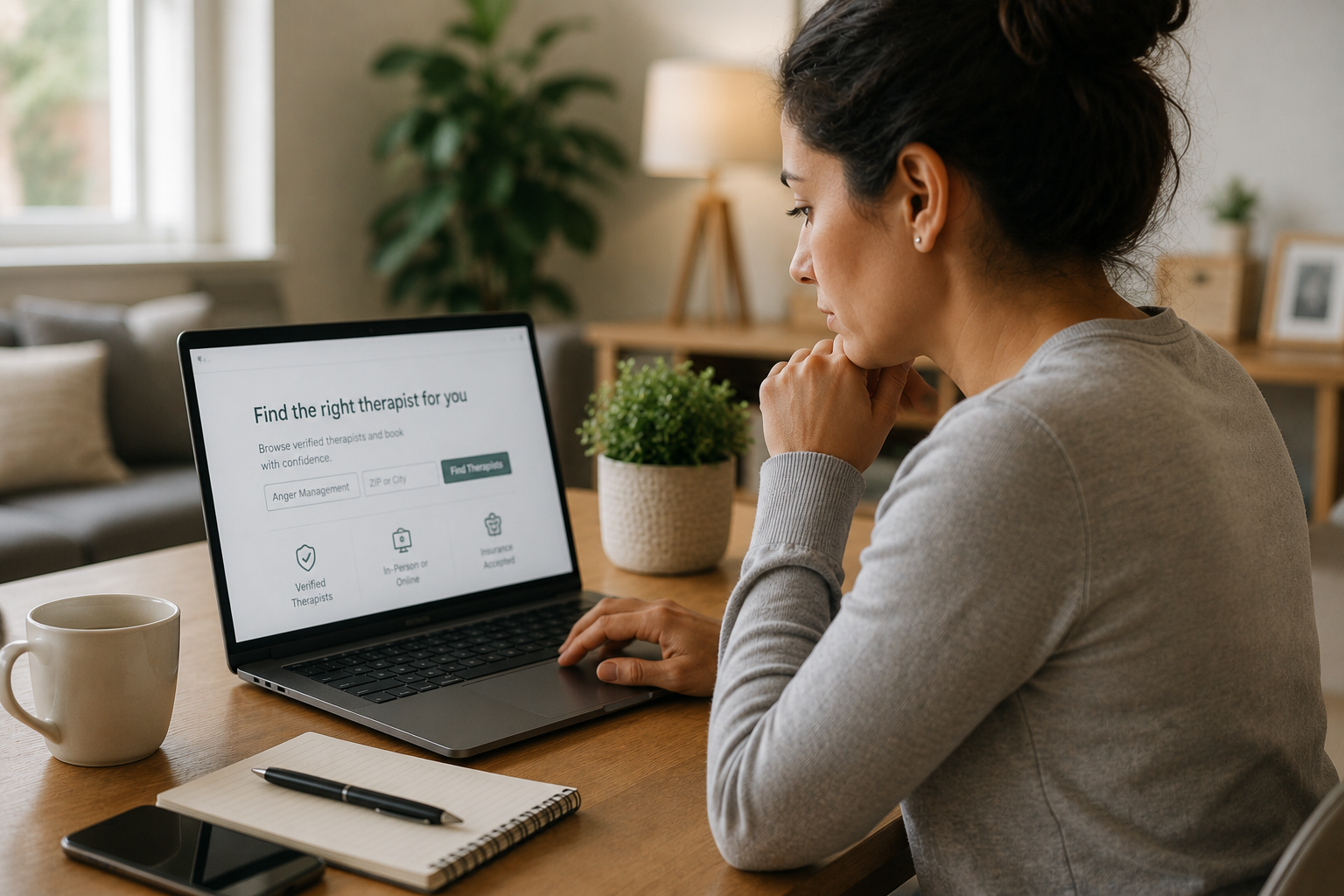

The internet allows for greater accessibility to those who may not be able to participate in in-person activities or events. Yet, it does come with its limitations, especially as it pertains to learning and mental health.
In our recent blog, we discussed the benefits of affordable online anger management courses. Here, we will be discussing the differences between virtual anger management classes versus in-person anger management classes.
When I search the internet for “anger management classes near me,” for instance, the options that pop up are primarily services available online. This level of accessibility benefits those who cannot physically reach an in-person destination, as well as those who need more flexible scheduling. For example, if someone is court-ordered for 12 weeks worth of classes in anger management and that person has a full-time job, chances are, a person in such a predicament may benefit from the flexibility of online services. People may even take advantage of these online classes during lunch breaks and so forth, allowing for better efficiency in completing the coursework.
Yet, what we have to consider here is that there is a reason most courts, as well as California Association of Anger Management Providers (CAAMP), often suggest one class per week for an extended period of time. It is because that extended allotment of time is how theoretical teachings can be put to practice to achieve long-term change. As each week passes, the time to process and digest the information increases to better ensure lasting results.
Even at Anger Management 818, we offer a variety of online classes from Monday through Saturday, yet we recommend our volunteers and court-ordered clients alike to choose one class per week for a minimum of 26 weeks. Although, the workbook we utilize in the class does extend to a full 52-week program. That being said, Anger Management 818 is also a standout option for anger management virtual services because the curriculum, live counselor, and pedagogical practices remain the same as it would with in-person facilitations of the class.
Technical Difficulties
How often do internet connections give out or Zoom calls disconnect? The answer is one we know all too well: and that is that online services fall victim to technical difficulties unexpectedly and frequently. When it comes to wellness and bettering one’s mental health, this could be frustrating and possibly impede the delicate process of self-improvement through anger management.
Moreover, the stressors of at-home or work environments may also disrupt learning in the makeshift classroom of a virtual video call. Whether it be dogs barking, children playing, or people chattering, not everyone has a quiet space that is conducive to learning readily available for them. Sometimes leaving one’s home and entering an actual classroom can tremendously benefit the learning process.
In-Person Connection
According to a meta-analysis of reading from a piece of paper versus a digital screen in the Journal of Research in Reading, a phenomenon known as the “screen inferiority effect” emerged in the research findings (Clinton, 2019). This occurrence implies that reading from paper produces more information retention and comprehension of material than viewing it through a digital screen. Although this does not prove that the medium of learning through a screen versus in-person hinders one’s education, it does mean that online learners often overestimate their ability to comprehend reading material provided through a screen. Therefore, students of virtual classes need to make sure they understand the material, and those instructing the course online should provide reading materials on paper, in order to be more conducive to learning.
Research consistently suggests that learning outcomes are influenced more by instructional quality as a catalyst for student engagement than by whether instruction is delivered online or face-to-face. Meta-analyses by Means et al. (2010), Bernard et al. (2004), and decades of “No Significant Difference” research indicate that when instructional quality is held constant, differences in student achievement across delivery modes are often minimal. Rather, instructors and facilitators of online classes should put more stress on the quality of teaching and facilitation of course materials with classes delivered virtually to offset the “screen inferiority effect.”
Not only does the intimacy of pen and paper resonate with people, but so do in-person interactions. That same connection may get lost behind a screen on the other side of a virtual call.
How often have you heard therapists who say they refuse to provide online services? It is not as common as we may expect, especially living in a post-COVID era. In 2023, a survey of over 500 licensed psychologists reported that the majority of them used telehealth or hybrid services versus in-person services (APA, 2023). Often, a brick-and-mortar office building is not necessary for a successful therapy business to run itself. This is because the virtual aspect of online services allows for anywhere to be turned into a temporary office. All one needs is a quiet space and an internet connection. Also, clients may feel more comfortable at home on a couch or in bed versus in an office setting when being vulnerable in therapeutic sessions. Programs that offer video calls, such as Zoom, can blur out your background, making a physical environment less conspicuous. It therefore seems that convenience and accessibility have shown effective in the mental health industry, especially in terms of commerce.
Which Is Better?
For a potential client of anger management services, programs offering virtual classes should be vetted properly before signing up to attend, if the person wants to benefit from the material taught. Make sure the program chosen provides a live counselor and physical reading materials, such as our Anger Management Essentials workbook, which must be obtained before attending classes at Anger Management 818.
Potential clients should also look out for success stories within any given program. For Anger Management 818, we have had numerous clients return, often years later, to rejoin the program as a refresher course. We even hear from clients who were referred by former participants of our program.
Ultimately, virtual classes may be a better option for those seeking convenience and flexible scheduling, but in-person classes also provide a warmth and connection that virtual classes may not. At Anger Management 818, we remain one of the few programs that offer both these options at affordable prices.
___________
American Psychological Association (APA). (2023). Psychologists reaching their limits as patients present with worsening symptoms year after year: 2023 Practitioner Pulse Survey.
Bernard, R. M., Abrami, P. C., Lou, Y., Borokhovski, E., Wade, A., Wozney, L., Wallet, P. A., Fiset, M., & Huang, B. (2004). How does distance education compare with classroom instruction? A meta-analysis of the empirical literature. Review of Educational Research, 74(3), 379–439.
Clinton-Lisell, Virginia. (2019). Reading from paper compared to screens: A systematic review and meta-analysis. Journal of Research in Reading.
Means, B., Toyama, Y., Murphy, R., Bakia, M., & Jones, K. (2010). Evaluation of evidence-based practices in online learning: A meta-analysis and review of online learning studies. U.S. Department of Education.

Annette Semerdjian is the Client Experience & Marketing Coordinator at Anger Management 818. She is a multi-media journalist and administrative professional who spends her free time volunteering at animal shelters and writing poetry.